

Table of contents
The great dilemma of technological innovation
Companies developing technological innovation —from the source code of complex software to the technical plans of an industrial or architectural design— face a critical crossroads when protecting their intangible assets. The dilemma is evident: how can we certify authorship, possession and existence of our confidential files on a given date without having to expose them or deposit them on third-party servers?
The most technically advanced and legally solid solution does not consist in sending the file itself, but in certifying its immutable cryptographic representation: its digital fingerprint.
Content vs. cryptographic representation
The fundamental principle of this model lies in the mathematical separation between an original document and its cryptographic identifier. A hash function, specifically the standardised SHA-256 algorithm, processes any set of binary data and generates a unique alphanumeric string of fixed length.
The magic of one-way cryptography ensures two indispensable properties for the corporate environment:
- Absolute immutability: Any modification to the original file, however minor (such as changing a single character in thousands of lines of source code), will produce a completely different and chaotic fingerprint. Certifying this hash is equivalent to certifying the integrity of the entire file at a precise point in time.
- Mathematical irreversibility: The process is strictly unidirectional. It is computationally impossible to reconstruct, decrypt or deduce the content of the original document from its hash fingerprint. This guarantees that confidential information or trade secrets never leave your company’s local environment.
Taking the model to the extreme: Merkle Trees
What happens if your infrastructure needs to certify thousands of files, plans or development records daily on a mass scale? Registering hashes one by one would collapse audit systems. To resolve scalability, modern cryptography uses so-called Merkle Trees, the same structure that underpins trust in technologies such as blockchain.
The process operates in an automated pyramidal hierarchy:
- The system locally calculates the SHA-256 hash of each document individually.
- Those fingerprints are paired and reprocessed, obtaining “hashes of hashes” successively at different levels.
- The tree culminates in a single final master fingerprint known as the root hash (Merkle Root).
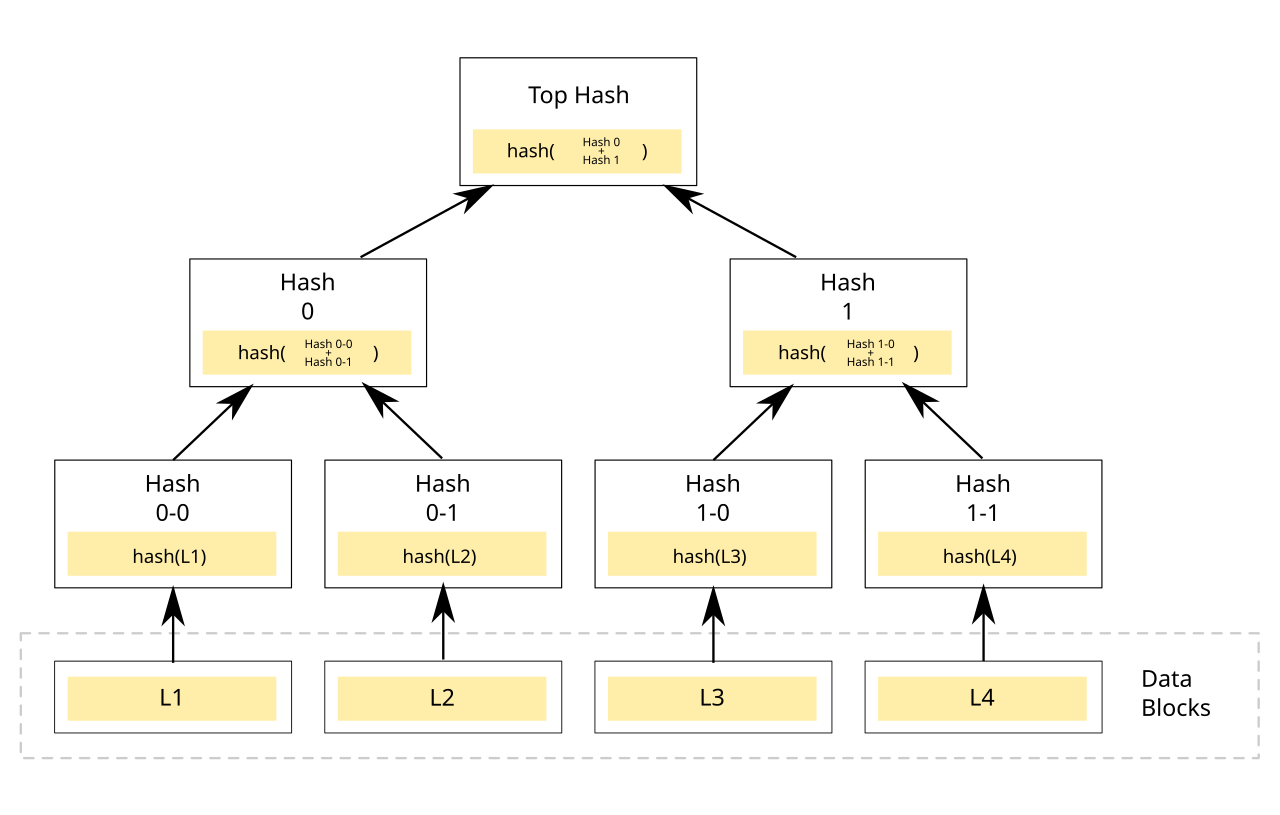 (Source: Azaghal)
This root cryptographically represents the entire volume of indexed documents. If a single file in the database were altered or deleted, the tree root would change completely, revealing manipulation. In this way, certifying the root hash before a trusted third party is equivalent to protecting the integrity of each individual document with minimum storage consumption and zero data exposure.
The technical and operational golden rule
Despite its extraordinary confidentiality and control advantages, it is critical to understand the legal and procedural scope of this preventive mechanism.
A fingerprint certificate reliably accredits that, on an exact date and time, you possessed a document with that specific hash. However, if your team deletes or loses the original file, the certificate alone cannot reconstruct the information.
Therefore, the company’s archiving policy must be rigorous: the certificate issued by the trusted platform must be kept securely and permanently in the same folder structure alongside the unaltered original file. Only by having both pieces can it be demonstrated in the future that they correspond unambiguously to each other.
Does it have full validity before the courts?
The legal answer is affirmative. Within contemporary procedural law, the use of cryptographic hash functions is a fully accepted technique for verifying the integrity of electronic evidence.
The European eIDAS Regulation, as well as Spanish case law and forensic IT practice, recognise this mechanism as a suitable and highly reliable means of demonstrating that digital evidence has not been manipulated since its creation.
As SHA-256 is a standard, international algorithm, it enjoys universal reproducibility: any independent expert or court can recalculate the fingerprint of the preserved file using native tools of any computer’s operating system (such as the command console or terminal) to verify that it matches the certificate, providing irrefutable evidential solidity in intellectual property or unfair competition litigation.
Frequently asked questions (FAQs)
How is the hash generated internally without third-party tools? No proprietary software is required. It can be calculated directly from the operating system terminal of any device:
- On Linux: sha256sum file.zip
- On macOS: shasum -a 256 file.zip
- On Windows (PowerShell): Get-FileHash file.zip -Algorithm SHA256
Does this method replace official Patent and Trademark registration? Not in all areas. It is an optimal and very economical solution for protecting intangible assets such as trade secrets, software source code, algorithms or internal methodologies (intellectual property). However, for industrial property (trademarks, patents or utility models), formal registration with official bodies remains mandatory to obtain exclusive rights.
What happens if the certified document undergoes a minor subsequent modification? Any change will generate a completely different hash. If the document evolves (for example, a new version of a plan or code), the new file must go through the same hash obtaining and certification process, thus creating a perfectly dated and protected version history.
Conclusion
Protecting intellectual property in highly competitive and innovative environments no longer requires choosing between the slow bureaucracy of traditional deposits or the vulnerability of exposing confidential data.
Certifying the SHA-256 digital fingerprint of your files allows innovative organisations to build an immediate, unalterable and cost-efficient preventive legal shield. By relying on universal cryptographic standards and trusted digital infrastructures, companies protect the value of their technological developments, guarantee the secrecy of their competitive advantages and ensure an incontestable evidential advantage ready to be activated in any judicial conflict.
Ready to get started?
Contact us to share your business project or register now to start trying our services today